
Information Regarding MN Opera Economics and Orchestra Negotiations
OVERVIEW
This is an incredibly complex time for the performing arts. Subscriptions have fallen sharply across every art form at a time when foundation and corporate funding has grown scarce, even while costs have risen significantly. Minnesota Opera and arts organizations across the country are being forced to rebuild audiences and support with constricted resources.
While inflationary expense growth has outpaced revenue growth in the arts for decades, it has recently skyrocketed. The expenses of producing opera – from steel, lumber, and shipping, to printing, housing, and labor – have driven local costs up more than 54% in the last 10 years, resulting in a growing annual structural imbalance.
To manage declining revenue and increasing costs, MN Opera reduced its season from five productions to three and articulated a strategic objective of preserving a three-opera mainstage season at the Ordway as the foundation of our public offerings through fiscal year 2028. While still exploring other performance options, this mainstage baseline is a responsible reaction to market forces driving difficult decisions to maintain a sustainable organization. In short, we are adjusting to the economic reality we face, which unfortunately continues to conflict with where we strive to be.
The reduction of the number of opera productions in MN Opera’s season impacts our entire creative workforce, most of whom are Minnesotans. The orchestra is one of many essential components in MN Opera’s fully staged opera productions. Everyone is impacted – from singers, visual artists, and craftspeople to the instrumentalists in our orchestra; and it would be financially irresponsible and contrary to MN Opera’s values to privilege one part of our creative workforce with unsustainable increases in pay to the detriment of the rest of the workforce.
Sources:
Opera America Annual Field Report
Opera America 2023 Annual Field Report
Claims vs. Facts: Understanding the Context
During the course of negotiations to arrive at a fair and equitable agreement, there have been a series of allegations and mischaracterizations that require correction and/or clarification. MN Opera will continue to update this page as needed.
Key Facts and Information
MINNESOTA OPERA’S BUSINESS MODEL
- How does Minnesota Opera generate cash to sustain operations?
- What is the current financial state of Minnesota Opera?
- How does Minnesota Opera balance revenue and costs?
- Isn’t it simply a matter of raising more funds?
- Why has the number of Minnesota Opera’s productions been reduced?
- Wouldn’t more productions raise more revenue, and eventually profits?
- Okay, so can you just add more performances for the productions already created?
CURRENT ORCHESTRA MUSICIANS UNION NEGOTIATIONS
- What are the key issues of the negotiations between Minnesota Opera and the Union representing its orchestra musicians?
- How are Minnesota Opera Orchestra musicians compensated?
- What is Minnesota Opera offering its orchestra musicians?
- Are Minnesota Opera Orchestra musicians full-time employees? How often do they perform?
- When does the current collective bargaining agreement between the Minnesota Opera Orchestra Musicians and Minnesota Opera end?
- What is the impact of unworked hours on the Minnesota Opera?
- Why did Minnesota Opera management file an Unfair Labor Practices charge?
- Who is representing each party at the at the negotiation table?
- Both sides are advocating for higher orchestra musician pay, so how do the compensation increases for the orchestra musicians differ?
- What financial information does MN Opera share with the orchestra musicians during negotiations?
- Will the orchestra musicians still be paid even though they aren’t playing?
Minnesota Opera’s Business Model
How does Minnesota Opera generate cash to sustain operations?
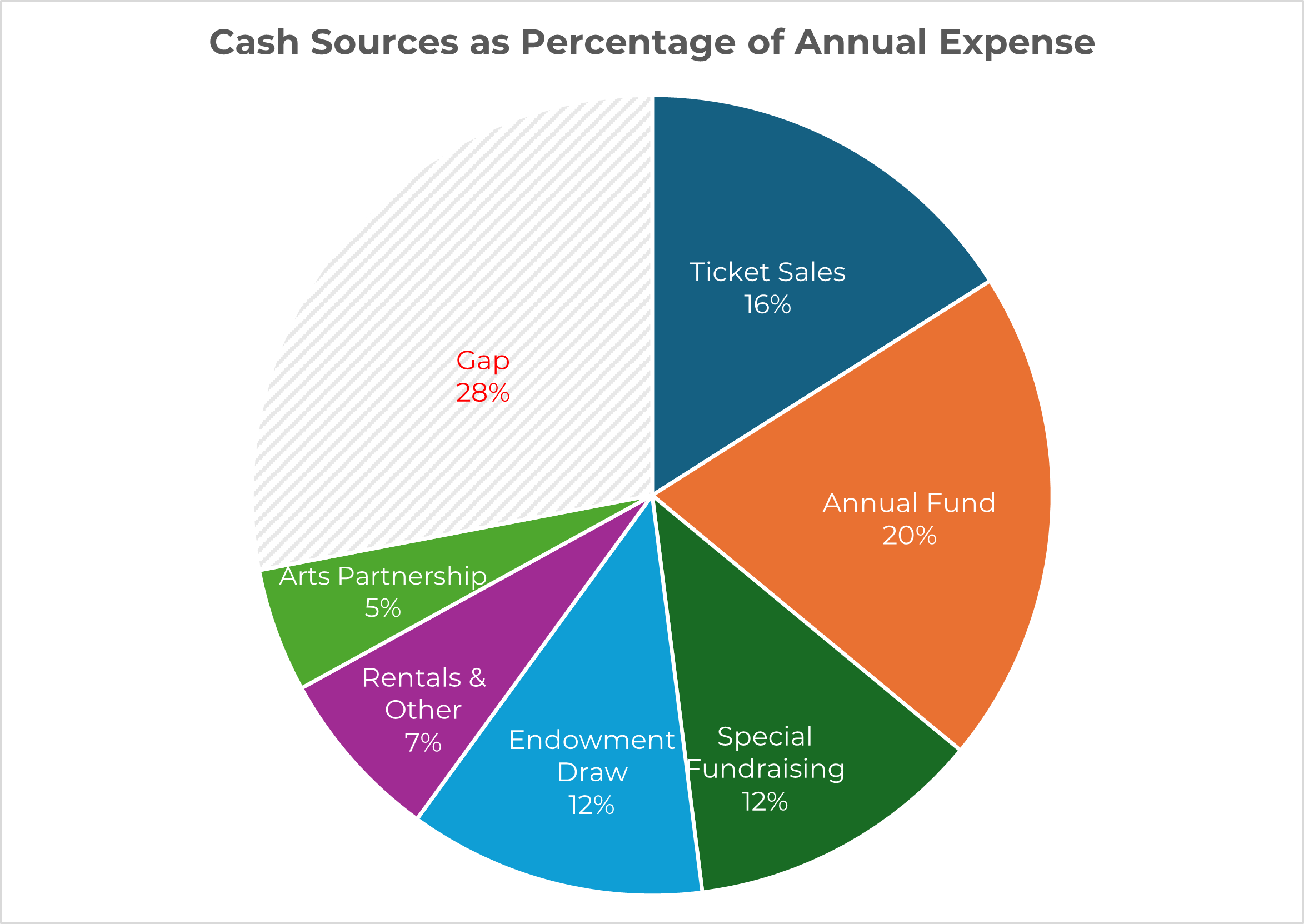
As a nonprofit organization, MN Opera exists to serve its community and does so by utilizing various sources of revenue provided by that community to support its operations. MN Opera’s three main sources of cash are ticket sales, donations, and draws from its endowment. Last season, ticket sales covered 16% of our expenses, contributions to our annual fund and special fundraising campaigns covered 32%, and a 4.5% draw from our endowment covered 12% of expenses. Additionally, a subsidy from the Arts Partnership covered 5%, while space rentals and other income contributed 7%. This leaves a 28% gap between cash sources and expenses and is not sustainable.
What is the current financial state of Minnesota Opera?
The arts in general are suffering economically, and MN Opera has an increasingly unsustainable structural imbalance between annual revenue and expenses. For decades, costs have increased at a faster rate than revenues; a reality faced industry wide.
This growing divide between revenue and inflation-driven expenses leaves the company in an untenable cash-flow position. With the support of our board, MN Opera drew an additional $2.5M from its endowment to cover the fiscal 2026 gap. While this was a necessary and reasonable decision, it is an extraordinary measure indicative of our current financial reality and not something that can be repeated each year.
How does Minnesota Opera balance revenue and costs?
MN Opera attracts loyal and new audiences, raises money from donors annually, and has a healthy endowment, but this is not enough to prevent the rising gap between expenses and revenues. While the Opera has been able to sufficiently address the gap for many years through expense cuts, changes in programming, and additional endowment draws, the increasing gap is unsustainable.
The economic challenges faced by MN Opera and other arts organizations are happening across the performing arts industry. It’s a decades’ long economic reality that has been becoming increasingly acute. Ticket sales (even with well-sold houses) cover only about 16% of the expenses of producing opera, and we have always relied on contributions from our community. Opera has always required a level of subsidy and now requires even more significant donations to make up the difference between ticket revenue and expenses at a time when charitable giving is constricting.
MN Opera, like most performing arts organizations, has had no choice but to reduce programming. We lose significant money every time we open the curtain and have unfortunately had to reduce the season from 5 operas and 28 performances in 2006 to 3 operas and 14 performances today. Many opera companies have seen contractions in programming; this is not unique to MN Opera.
Isn’t it simply a matter of raising more funds?
While the number of donations and the amount of annual revenue raised has grown in recent years, the company cannot replace the large contributions that once came from corporate, foundation, and government sources quickly. It is costly and takes time to replace lapsed donations from the same community.
Performances – By the Numbers
Why has the number of Minnesota Opera’s productions been reduced?
Since the 2023 season, the MN Opera has produced a three-opera season, with the 2025- 2026 season including a fourth opera in concert (Edgar).
MN Opera leadership and Board conduct complex and thoughtful budgetary modeling and planning in order to sustainably and responsibly create seasons that maintain the highest level of artistic integrity while navigating market and financial realities. The strategic decision to focus efforts on fewer productions allows us to build a stronger future, rejuvenate our approach, and continue delivering exceptional opera experiences.
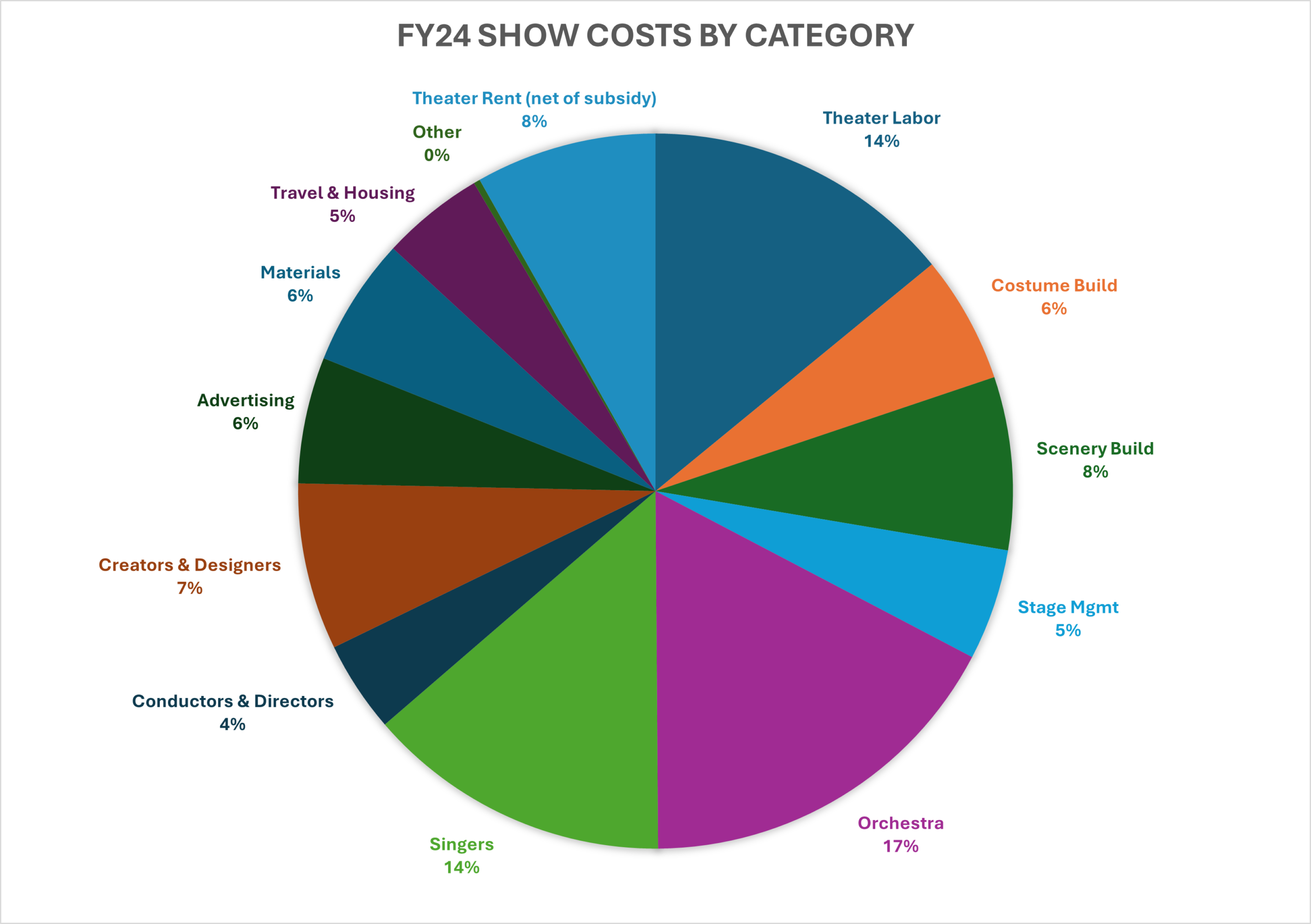
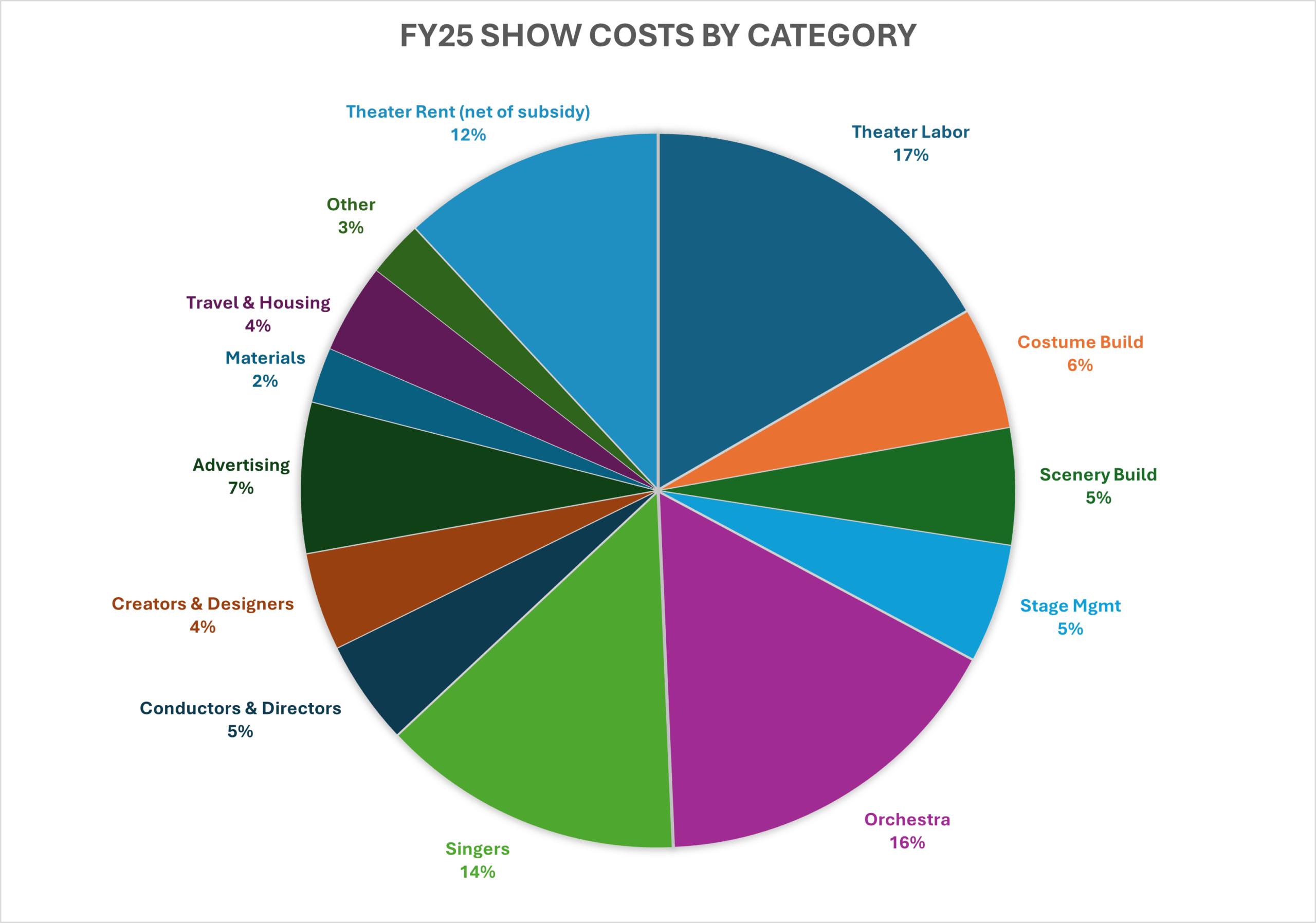
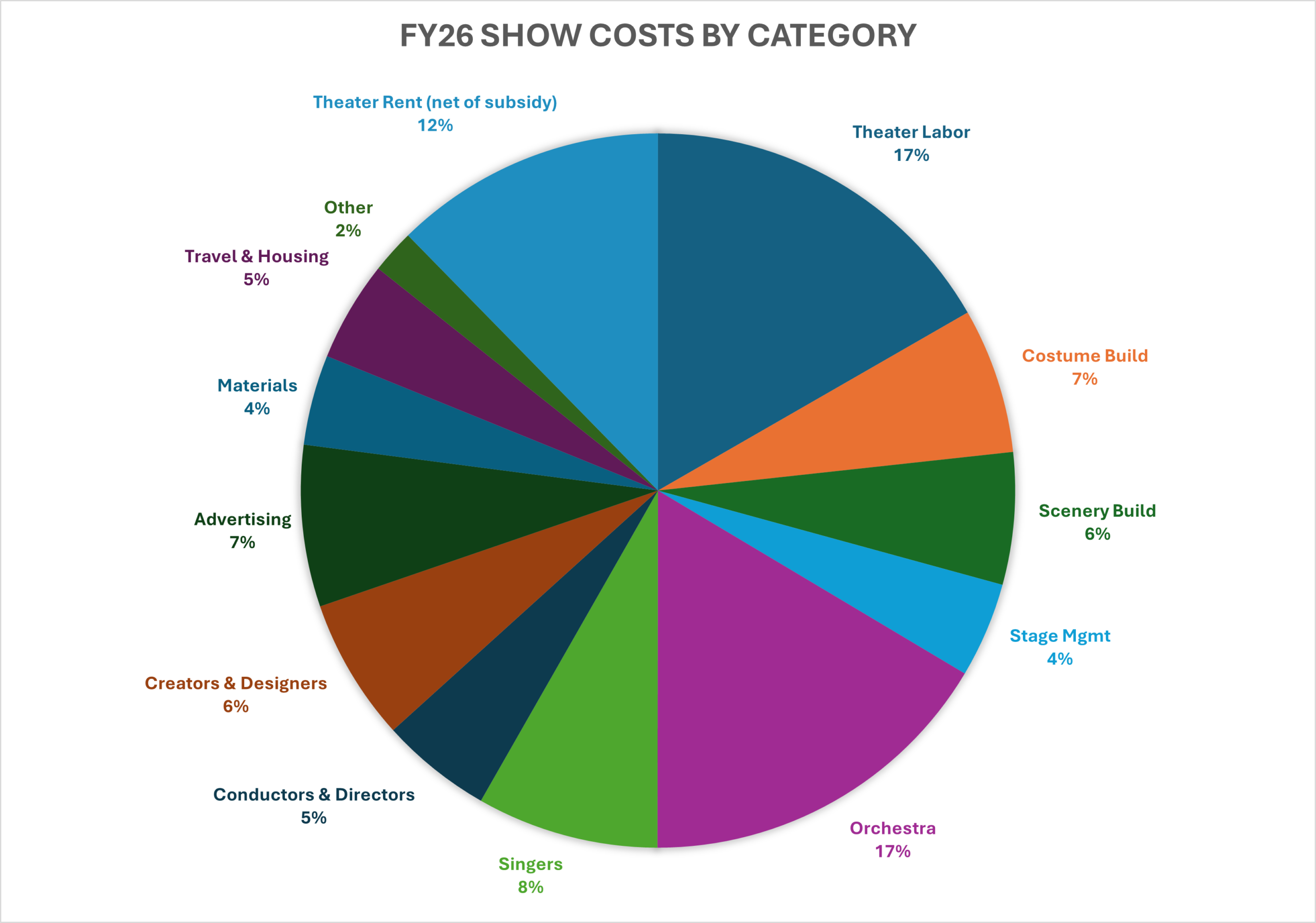
Wouldn’t more productions raise more revenue, and eventually profits?
It is a natural assumption that more performances equal more ticket revenue. However, more performances only increase the gap between expenses and revenue. When ticket revenues cover only 16% of our expenses, adding more performances results in net loss to the organization.
For example:
• To add another performance of last spring’s Pagliacci would have resulted in projected net loss of $80k including anticipated ticket revenue.
• The Edgar concert performances last April resulted in a net loss of $346k after ticket sales were accounted for.
Every public performance we offer results in net loss and requires additional donor subsidy. This is true from the grandest of grand operas on the Ordway stage to intimate experiences in the Luminary Arts Center. We cannot solve a structural imbalance by adding programming. Adding programming increases the net loss to the organization.
Okay, so can you just add more performances for the productions already created?
The number of performances we can schedule for each production is based on two primary factors – the time available in our performance home, which is determined by a master agreement, and the popular appeal of the opera title. When the per-performance costs exceed the likely potential revenue, it does not make sense to add additional performances.
Current Orchestra Musicians Union Negotiations
What are the key issues of the negotiations between Minnesota Opera and the Union representing its orchestra musicians?
Over the past four years, orchestra musicians have been compensated through payments per service (e.g., rehearsals or performances) and have had a guaranteed minimum salary. For some orchestra musicians, the minimum salary exceeded what they would have earned through service rates alone. At the bargaining table, MN Opera has repeatedly expressed its desire to fairly compensate orchestra musicians for the work they are performing and has proposed significant increases to orchestra musician scale rates and the overscale premiums provided to orchestra musicians with additional responsibilities. MN Opera has not proposed increases to the minimum salaries, and has declined the Union’s proposals for substantial increases to the minimum salaries because such increases represent payment for work not performed.
While MN Opera remains open to continued negotiations and will consider any proposals put forward by the Union in good faith, the organization feels strongly that paying more for services not worked is not a responsible or sustainable business model, particularly in the current environment. It would also set up an inequitable privilege for one of our artist groups above the others – all of whom are integral to the collaborative artistic work that is inherent in the creation of opera. The Union has indicated they will not agree to a contract that does not include such increases and, as a result, they have unilaterally declared the parties to be at an impasse, asserting there is nothing more to discuss.
We hope to reach an agreement for a new collective bargaining agreement that recognizes the tremendous value our orchestra musicians provide while sensibly and responsibly aligning their contract with the current reality of the company. We hope that this information will help give some helpful context for the current economic situation of the company and the negotiations between MN Opera and the Union representing its orchestra musicians.
How are Minnesota Opera Orchestra musicians compensated?
Orchestra musicians are paid a per-service rate, called “scale.” A service is a rehearsal or performance lasting three hours. Section leaders (titled chairs such as Concertmaster and Principal) are paid a set percentage over scale. MN Opera pays pension contributions of 9% as well as all applicable taxes (FICA, unemployment, worker’s comp, PFML).
All orchestra musicians are currently guaranteed a minimum compensation amount of $12,500 per season, which is roughly the equivalent to the value of 53 services at scale rates from the previously expired CBA.
What is Minnesota Opera offering its orchestra musicians?
MN Opera’s economic proposals provide for increases in two primary areas:
- Scale rates. MN Opera is proposing unprecedented increases in scale rates over a four-year period so that orchestra musicians reach their minimum compensation amount faster and have more opportunity to earn above the minimums.
- Overscale rates. MN Opera is proposing to raise overscale rates for section leaders (titled chairs) with the aim of providing compensation for those individuals that exceeds the minimum guaranteed to all, in recognition of the leadership demands those titled positions entail.
MN Opera sees minimum compensation as a true baseline and safety net, not an aspirational reflection of orchestra musicians’ value. With MN Opera finding it hard to fund and support its current level of programming, raising minimums only increases the amount paid for unworked services and does not fit a sustainable or responsible business model that would prudently steward the funds donated by our community in support of our company. We want to focus instead on putting more value into the work actually performed.
Are Minnesota Opera Orchestra musicians full-time employees? How often do they perform?
No. MN Opera Orchestra musicians are part-time employees who freelance with any number of Twin Cities and greater Minnesota organizations. Many teach their own studios, whether privately or as part of a university position.
The most services offered to any orchestra musicians for the current season is 45, and the least is 23. A standard production at the Ordway usually involves 7 rehearsal services and 4 – 5 performance services. Workshops and operas in concert encompass a much shorter rehearsal period involving 3 rehearsals and 1 – 2 performances. This number of services translates to roughly three weeks of work annually for most of our orchestra musicians.
When does the current collective bargaining agreement between the Minnesota Opera Orchestra Musicians and Minnesota Opera end?
The most recent contract ended June 30, 2026. On June 29, MN Opera management offered to extend the current contract until a successor agreement could be reached. The orchestra musicians’ Union flatly rejected an extension of any length.
What is the impact of unworked hours on the Minnesota Opera?
MN Opera makes additional payments to orchestra musicians who are owed a balance at the end of a season – not for services provided but for contractually required minimum salaries. Minimum payouts to orchestra musicians for unworked services for the four years of the most recent collective bargaining agreement total:
- FY24 = $58,000
- FY25 = $64,000
- FY26 = $101,011
- FY27 est: $149,000
Why did Minnesota Opera management file an Unfair Labor Practices charge?
MN Opera has filed an unfair labor practice charge because we do not believe the Union representing our orchestra musicians has met its legal obligations to negotiate in good faith, with a sincere effort to reach an agreement. The law requires both parties to engage in bargaining in good faith, even if they do not like the proposals the other side is making. This entails meeting regularly and genuinely attempting to reach compromises by engaging in the back and forth of bargaining, as opposed to simply going through the motions.
Since MN Opera provided the Union with its required notice of a desire to renegotiate the collective bargaining agreement, the Union has delayed negotiations and frustrated bargaining progress in a manner that is contrary to its legal obligations, including by agreeing to a very limited number of bargaining dates, failing to engage substantively with MN Opera’s proposals, refusing to substantively explain its proposals and positions, and, most recently, prematurely declaring impasse and refusing to continue to negotiate or make any further counter-proposals. While the Union has effectively suspended negotiations, we remain committed to reaching a fair agreement through good-faith collective bargaining. Our decision to file this charge reflects our belief that productive negotiations require both parties to meet regularly, engage seriously with proposals, and work toward meaningful compromise. We are committed and prepared to do that work at the bargaining table.
Who is representing each party at the negotiation table?
MN Opera is represented at the table by executive level staff leadership and its legal counsel, as well as Board representation. The Union also includes MN Opera Orchestra musicians and lawyers, as well as representation from the American Federation of Musicians, the national Union representing musicians.
Both sides are advocating for higher orchestra musician pay, so how do the compensation increases for the orchestra musicians differ?
Management’s current proposal to the orchestra musicians represents a 17% compounded increase in scale rates over the course of the contract. Conversely, the Union’s proposal focuses on minimum salaries, requiring the company to increase pay to orchestra musicians for hours not worked.
What financial information does MN Opera share with the orchestra musicians during negotiations?
MN Opera holds an annual financial review meeting with the orchestra Players Committee. Most recently, on November 18, 2025, the Union made a request for MN Opera financial information. MN Opera management responded with all requested information on December 18, 2025, and asked the Union to clarify some of its requests further if more information was needed. The Union responded thanking management for the information and indicated they would respond with any questions. Management received no further communication from the Union regarding the request that was made.
Will the orchestra musicians still be paid even though they aren’t playing?
We are operating under the status quo of our last agreement, which guarantees that the orchestra musicians receive fees for services canceled within 21 days of the scheduled service.
All artists, including orchestra musicians, will be paid their fees for this season’s production as originally contracted. We are determined to bring this remarkable work to audiences in the future under circumstances that honor its creative ambition and the people responsible for realizing it.
For all media requests and inquiries, please contact Associate Director of Marketing and Communications, Isaac Mayhew, [email protected].