Director’s Note

Mary Birnbaum
Stage Director
A shoebox containing immortality, the Goddess of Death hell-bent on revenge, tight-knit communities that come together to work and mourn, party and pray. And in the middle of it, a girl with long raven hair who has lost track of the meaning of life, and whose body will be repurposed by Death on an epic spiritual journey which begins with a mission to defeat an arch-nemesis, but ends with gratitude for life itself, with all its many contradictions and blessings.
Like many of the greatest operas (Orfeo, The Ring Cycle, Ariadne auf Naxos), The Many Deaths of Laila Starr tells the story of gods who are as lost as humans beings. And like in so many Hindu epics, in order to save the world, a deity, in this case Death, takes on a human form to fight a demon.
Ram V’s original graphic novel reads like a love letter to modern Mumbai with its dense population, chaotic traffic jams (4 people on a motorcycle!), fragrant chai, spiritual corners, omnipresent crows, and the presence of so many ancestors burned at ghats and mourned with marigolds and rice. Kamala’s music transports us to ritual spaces with chanted mantras, to parties with EDM DJ sets, and to the office of the gods with typewriters and Konnakol vocal percussion. The storytelling is on an epic scale: Minita’s words flow lovingly from each of the many characters’ mouths- singers play two, sometimes three different characters.
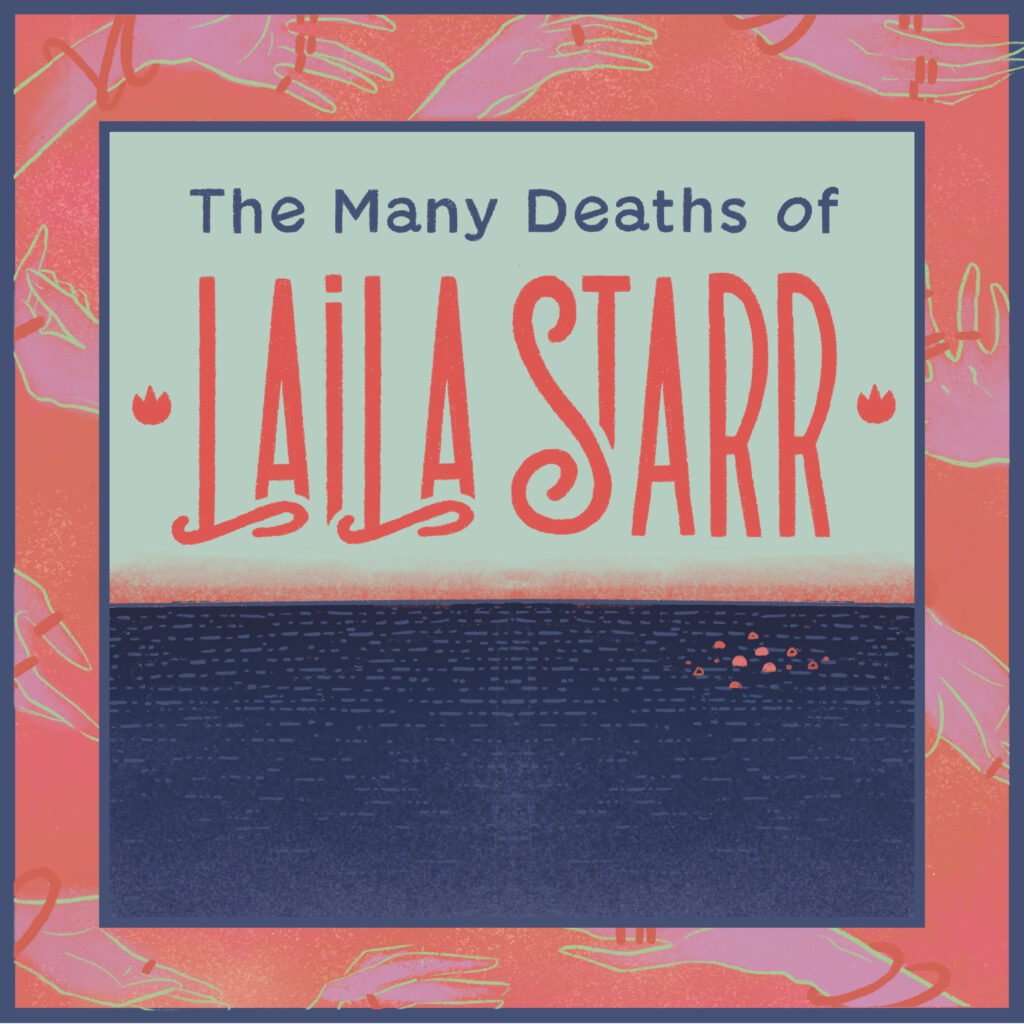
Mimi, Oana, Anshu, Rohit, Miriam, and I worked to find a visual landscape for Laila Starr where the divine and contemporary collide. This is a world where Indian Classical Fusion and street dance styles battle, where the colorful, chaotic streets of Mumbai spill out of the geometric panels on a comic book page, and where gods hilariously emulate humans and humans scarily accumulate godlike powers to gain control over the uncontrollable: death, aging, loss. We follow our hero, Death/Laila, free-falling through time and space at the pace of an action movie as she pursues Darius Shah- each scene set in a new location, but always in front of the unifying vista of the Arabian Sea, black and wavy like Laila’s hair.
And as for our hero – or is she a hero? She’s trying to kill a child, after all. As I started to research Kali, I learned that she has her own version of a Tandav, Shiva’s cosmic dance of destruction usually performed when battling an enemy. But the destruction in the Tandav is not purely negative; it tears down illusion and ego to clear the path for rebirth, transformation, and universal renewal. The opera of Laila Starr resembles a Tandav, for even as death ravages scenes, the story reveals to us the liberation of being awake to the present moment.
Kamala, Minita, and Laila Starr remind us to walk through the world with a sense of irony and a tender heart. The opera asks a pressing question: in 2026, in the messy middle of our improbable, sometimes terrifying, often out of control lives, can we let go, open our hearts, and remember how precious life is?