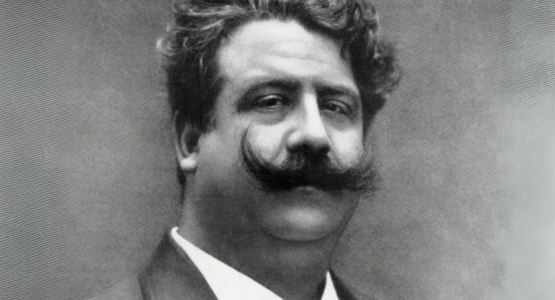
Ruggero Leoncavallo
B. Naples, Italy April 23, 1857; D. Montecatini, Italy August 9, 1919
Ruggero Leoncavallo was born to a household of comfortable means. Though the family originally was from Naples, his father’s career as a magistrate led them to other cities (including Montalto, which has some bearing on Pagliacci). Leoncavallo studied music at the Neapolitan Conservatory, then at Bologna University. It was there that he met Richard Wagner, who was in town for that city’s premiere of Rienzi, and the encounter had significant repercussions on the younger composer’s future works. He soon produced his first opera, Chatterton, set to text he had written himself.
After brief stints in Egypt and Paris (where he met several influential figures and lived la vie bohémienne), Leoncavallo settled down in Milan. He intended to create an epic work, an Italian “Ring Cycle,” titled Crespusculum. The first installment, I Medici, was submitted to the publishing house of Ricordi, which paid for the score but was in no hurry to produce the work; instead they asked Leoncavallo to work on Puccini’s libretto for Manon Lescaut. He would be one of five to attempt to satisfy the troublesome young maestro.
Victor Maurel, an acquaintance from Paris (and Verdi’s first Iago and Falstaff), was instrumental in making the Ricordi contacts. In return Leoncavallo wrote Pagliacci for him to perform and provided an extended prologue for his character Tonio. Somewhat indignant about I Medici, Leoncavallo offered Pagliacci to another publisher, Sonzogno, who snatched it up immediately and reaped the rewards. Sonzogno also purchased I Medici from Casa Ricordi and produced it the following year.
Leoncavallo’s next work was an adaptation of Murger’s Scènes de la vie de bohème for the operatic stage. This led to one of the more heated rivalries of the late 19th century, for Puccini announced he also was planning to produce an opera based on Henry Murger’s book, an intention he claimed to have had for several months. A contest soon ensued with the two composers airing their differences in the Italian newspapers. Of course, Puccini’s La bohème would later earn its place in posterity.
The composer is noted for a third work, Zazà, which was also well-received. The popularity of Leoncavallo’s operas in Germany led to a commission from the Kaiser. Der Roland von Berlin was the result, achieving nearly 40 performances. Following its premiere, Leoncavallo’s career seemed to wane. He tried his luck at operetta (La jeunesse de Figaro), followed by a return to verismo (Il piccolo Marat and Zingari), then a string of additional operettas. Toward the end of his life he endeavored to treat subjects of a more serious nature, but Edipo re and Prometeo lay incomplete at the time of his death in 1919.